


IGBT vs SiC vs GaN: A Deep Dive into Power Semiconductor Technology Roadmaps

Abstract
This report systematically compares the performance characteristics, application scenarios, and commercialization paths of IGBT, SiC, and GaN power semiconductor technologies. IGBT, based on silicon, offers optimal cost-performance in the 100kW-10MW power range. SiC, with 3x wider bandgap and 10x higher critical breakdown field, achieves 15-20% efficiency improvement in new energy vehicles and photovoltaics. GaN, through two-dimensional electron gas structure enabling ultra-fast switching, demonstrates significant cost-effectiveness in consumer electronics and fast charging markets.
Introduction: Power Semiconductor Technology Evolution and Industrial Value
As the "brain" of power electronic systems, power semiconductors directly impact energy efficiency improvements in new energy and industrial control sectors. The global power semiconductor market has reached $58.2 billion, with new energy accounting for over 40%. IGBT maintains dominance with mature cost-performance, while SiC and GaN show significant advantages in high-frequency, high-temperature scenarios.
Core Value: Power semiconductors are key devices enabling efficient energy conversion, determining performance metrics and cost structures of new energy equipment.
Material Properties and Working Principles
IGBT Material Properties and Working Principles
IGBT, based on silicon (1.12 eV bandgap), combines PN junction and MOS structure to balance low conduction loss with moderate switching speed. MACMIC IGBT products cover 600V-1700V blocking voltage with switching frequencies of 20kHz-50kHz.
Core Characteristics: Silicon-based IGBT offers optimal cost-performance in the 100kW-10MW power range, making it the mainstream choice for industrial converters and new energy vehicle inverters.
SiC Material Properties and Working Principles
Silicon Carbide (SiC) features 3.26eV bandgap (3x silicon) and 2.5MV/cm critical breakdown field (10x silicon), enabling operation above 200°C with over 50% lower conduction loss than silicon-based devices.
Performance Breakthrough: MACMIC 1200V SiC MOSFET achieves on-resistance as low as 80mΩ·cm² and 3x faster switching speed than silicon-based IGBT, reducing system energy consumption by 15%-20%.
GaN Material Properties and Working Principles
GaN forms two-dimensional electron gas (2DEG) at heterojunction interfaces, providing extremely high electron mobility and significantly faster switching speeds than traditional silicon devices with reduced parasitic capacitance. MACMIC 650V/60A GaN HEMT device features 50mΩ·cm² on-resistance and 2MHz switching frequency, achieving 94.5% conversion efficiency in 1.2kW fast charging power supplies.
Technical Advantages: GaN enables ultra-fast switching through high mobility 2DEG, with low parasitic capacitance optimizing high-frequency performance, excelling in low-voltage high-frequency scenarios like fast charging and inverters.
Comparative Analysis of Key Technical Parameters
Electrical Performance Comparison
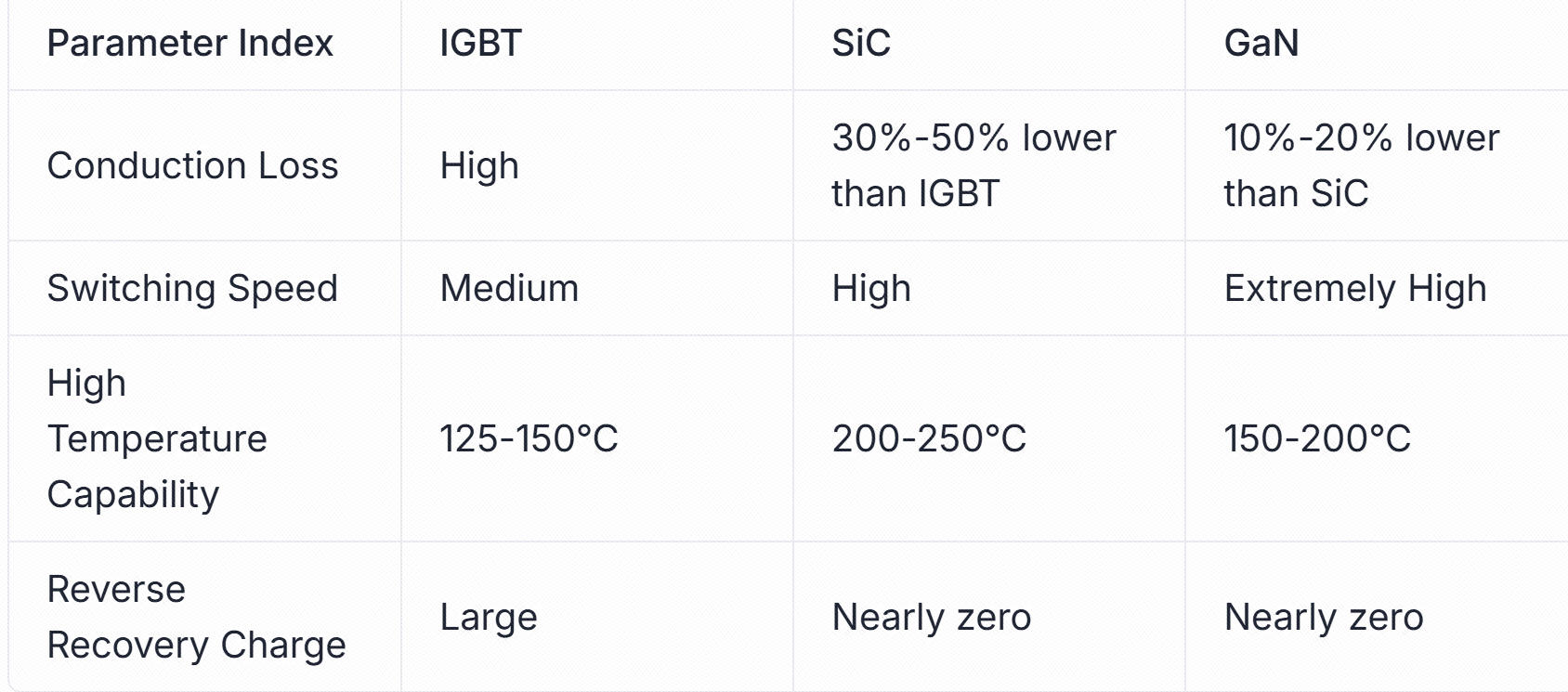
Performance Impact Analysis: SiC devices improve system efficiency through low conduction loss and zero reverse recovery characteristics, while GaN excels in high-frequency switching applications but requires cost and reliability optimization.
Cost and Manufacturing Process Comparison
Current cost comparison (1200V/100A specification): IGBT single tube ~$1.2, SiC ~$4.5 (3.75x), GaN ~$3.8 (3.17x). SiC substrate accounts for 40%-60% of total cost with manufacturing yield generally below 70%. SiC device costs are projected to decrease by 40% by 2025.
Cost Reduction Drivers: SiC substrate price reduction (40% by 2025), manufacturing yield improvement (targeting over 80%), and 8-inch production line scale-up.
Technical Adaptability Analysis in Four Key Application Fields
New Energy Vehicle Sector
Electric drive systems adopt 1200V/500A IGBT modules and SiC solutions, with SiC improving efficiency through high-frequency characteristics despite higher cost. On-board chargers (OBC) have lower power requirements, where GaN shows advantages in efficiency and miniaturization.
Technical Adaptation Logic
Electric drive systems: High power requirements drive IGBT/SiC applications
OBC modules: GaN offers advantages in cost-efficiency balance
Photovoltaic Energy Storage Sector
Central inverters primarily use high-power IGBTs, while string inverters gradually adopt medium-power SiC solutions. MACMIC photovoltaic-specific modules show SiC devices reduce levelized cost of electricity through efficiency curve and temperature characteristic optimization.
Industrial Control Sector
IGBT maintains core position in high-voltage, high-power scenarios with mature technology and stability, while SiC and GaN offer equipment miniaturization and energy optimization through higher switching frequency and efficiency. MACMIC industrial-grade IGBT drive solutions achieve 8%-12% system efficiency improvement.
Home Appliance Sector
Cost-sensitive markets primarily use IGBTs, with GaN and SiC entering high-end demand scenarios. MACMIC 650V/15A home appliance-specific IGBT chips achieve cost-performance advantages through optimized packaging and processes, becoming the mainstream choice for white goods inverter modules.
Technical Challenges and Solutions
IGBT Technical Bottlenecks and Breakthrough Directions
MACMIC optimizes carrier distribution to reduce switching losses and enhance heat dissipation and reliability through 7th generation FS chip structure and Press-Pack packaging innovation, breaking through high-frequency application limitations of traditional silicon-based devices.
SiC Technical Bottlenecks and Breakthrough Directions
MACMIC improves crystal quality to reduce costs through SiC substrate material research and development, and optimizes module packaging using silver sintering technology to enhance heat dissipation and reliability, breaking through industrialization barriers through dual approaches.
GaN Technical Bottlenecks and Breakthrough Directions
MACMIC optimizes gate drive technology to improve switching speed and anti-interference capability, develops multi-chip module (MCM) solutions to reduce parasitic parameters, enhancing GaN device reliability and reducing unit power cost.
Market Trends and Future Outlook
IGBT maintains dominance in medium-high power applications, SiC rapidly penetrates new energy vehicles and photovoltaic inverters, while GaN focuses on consumer electronics fast charging and industrial control low-voltage scenarios. The three technologies form complementarity based on performance advantages: IGBT dominates 1200V-1700V market, SiC expands in 2000V+ high-voltage fields, and GaN gains popularity in sub-650V low-voltage scenarios.
Conclusion
IGBT, SiC, and GaN technologies demonstrate significant irreplaceability and complementarity: IGBT holds core position in medium-low voltage, high-power applications; SiC becomes a key choice in high-end markets like new energy vehicles and photovoltaic inverters; GaN rapidly penetrates consumer electronics and communication power supplies.
Hot News
-

 2026.03.13GaN Power Devices: 98% Efficiency Breakthrough for AI Data Center Power Supplies
 -
 2026.03.11Power Semiconductor Packaging: The Double-Side Cooling Revolution
 -
 2026.03.10MACMIC Automotive IGBT Modules: Technical Advantages and Application Practices
 -
 2026.03.09GaN Power Devices: The Energy Efficiency Revolution in Data Center Power Supplies